

Signing in should be the least memorable part of your session. You tap a field, type a password, and you are back where you left off — with your balance, your bonus timers and your game history intact. Yet the login screen is also the single point where every security layer we run meets the everyday reality of forgotten passwords, patchy mobile coverage in regional Queensland, and browsers that quietly wipe stored data overnight. That combination is why we have written this page: not as a marketing sheet, but as the reference we would hand to a mate who keeps getting bounced back to the sign-in prompt.
Everything below is written for players in Australia, with local conditions in mind — NBN dropouts, mobile data throttling after the monthly cap, and the fact that a decent share of our traffic arrives from phones on the tram rather than desktops at a study desk. Our platform is built to tolerate all of that, but a few habits on your side make the difference between a two-second sign-in and twenty minutes of frustration.
We also want to be upfront about the regulatory picture. Australia’s Interactive Gambling Act 2001 restricts the supply of certain online casino products to Australian residents, and the ACMA enforces that framework. Anything you read here about account access, session control and verification is offered as informational guidance so that you understand how sign-in systems work and how to protect your own credentials — it is not an invitation to breach any law that applies to you. Take a minute to check your own position before you go any further, and if gambling has stopped being entertainment, skip the login entirely and speak to someone at Gambling Help Online.
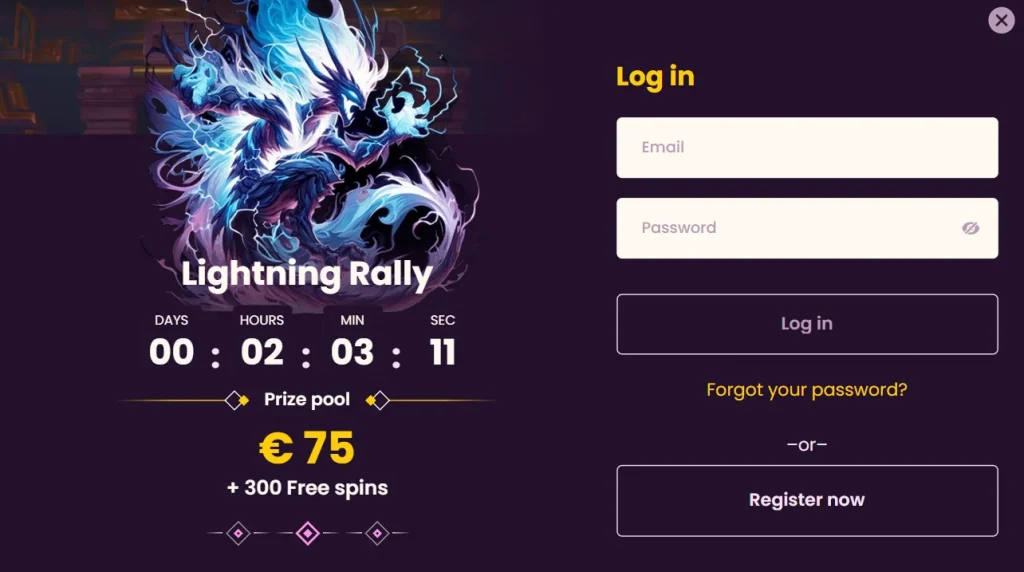
The Sign-In Sequence, Step by Step
The flow itself is short. Where players lose time is in the small decisions around it — which browser, which saved password, which email address they used eighteen months ago. Work through the sequence below once, deliberately, and the next hundred sign-ins take seconds.
- Open the site directly in your browser rather than through a search result, a bookmarked redirect or a link in a promotional email. Typing the address yourself removes the most common phishing vector in one move.
- Locate the sign-in control in the top-right corner on desktop, or behind the hamburger menu on mobile. It sits above the registration prompt on every screen size.
- Enter the email address you registered with. Case does not matter here, but stray spaces from a copy-paste do — check the start and end of the field.
- Type your password. If your manager fills it automatically, confirm the character count looks right before submitting; a partially filled field is the cause of a surprising number of “wrong password” reports.
- Complete the verification prompt if one appears. New device, new IP range, or a long gap since your last visit will each trigger it.
- Wait for the dashboard to load fully before clicking through to the lobby. Interrupting the handshake mid-load is what leaves you half-authenticated and confused.
If you would rather start from the front page and work inwards, the lobby at Bizzo Casino carries the same sign-in control in the header, so you never need to hunt through a menu tree to find it.
Devices, Browsers and the Quiet Settings That Break Access
Most access failures are not account failures. They are configuration failures, and they cluster around a handful of settings that people switch on for privacy and then forget about entirely.
Phones and Tablets
Mobile sessions are the majority of our traffic, and they carry two specific quirks. The first is aggressive battery management: Android’s power-saving modes will suspend background tabs and, on some handsets, clear their memory, which drops your session token. The second is the mobile-data compression some carriers apply, which occasionally mangles the handshake on slower connections. Switching to Wi-Fi for the sign-in itself, then returning to mobile data afterwards, resolves both.
Keep the browser itself current. An iOS or Android browser that is two major versions behind may not support the cipher suites our security layer expects, and the symptom is a login page that simply reloads without any error message at all — the most maddening failure mode there is.
Desktop and Laptop
On desktop the usual culprits are extensions. Script blockers, aggressive tracker blockers and some VPN browser add-ons will strip the cookie that carries your session. If you run any of them, whitelist our domain rather than disabling protection entirely across the web. That way you keep your privacy posture and still get a stable session.
Corporate and university networks introduce a second layer. Many run transparent proxies that inspect traffic, and gambling-category domains are commonly filtered at that level. If the page will not resolve at all on a work laptop but loads fine on your phone, the network is the answer, not your account.
Reading the Error Message: A Troubleshooting Reference
When sign-in fails, the message on screen usually points straight at the cause — provided you know how to read it. The table below maps the symptoms we see most often against their real origins and the fastest way through. Keep in mind that our support team can see the server-side reason even when the on-screen text is generic, so a quick chat message saves guesswork.
| What you see | Most likely cause | First thing to try | Typical time to resolve |
|---|---|---|---|
| “Incorrect email or password” | Wrong credential, stray whitespace, or an old password stored by the browser | Type the password manually rather than autofilling, then reset if it still fails | 1–3 minutes |
| Page reloads with no message | Blocked cookies, an outdated browser, or an extension stripping the session token | Try a private window with extensions off; update the browser if that works | 2–5 minutes |
| “Too many attempts, try later” | Rate limiting after repeated failed logins from the same address | Wait out the cooldown, then reset the password instead of guessing again | 15–30 minutes |
| Signed in, but the balance shows zero | Cached page served from an earlier session, or a different currency wallet in view | Hard refresh the page, then check the wallet selector in your account panel | Under a minute |
| “Account temporarily unavailable” | Pending verification, a security hold, or a self-imposed limit you set earlier | Contact support directly — this one is never fixed from the browser side | Same day, usually within hours |
| Verification code never arrives | Filtered email, a full inbox, or a mobile number that has changed | Check spam and promotions folders, then ask support to reissue | 5–10 minutes |
One pattern worth naming: if the same error follows you across two different devices on two different networks, the cause sits with the account, not the hardware. That is the point to stop troubleshooting and open a support ticket instead of burning another half hour.
Recovering an Account You Have Locked Yourself Out Of
Password resets are ordinary and nothing to be embarrassed about — we process them constantly. What slows people down is attempting recovery from an email address they no longer control, or answering security prompts with details that do not match what was entered at registration.
The reset itself follows a predictable path. Request the link from the sign-in screen, open it from the same device where possible, and choose a new password that you have not used on any other site. The link expires deliberately quickly, so do not request it during your lunch break and act on it that evening.
Where the registered email itself is gone — an old work address, a defunct provider — the reset link is useless and you will need identity verification through support. Have your photo identification ready before you start that conversation. Attempting it without documents simply adds a round trip.
- Before you request anything: confirm which email you registered with by searching your inbox for the original welcome message.
- During the reset: avoid recycled passwords, dictionary words and anything containing your date of birth.
- Immediately afterwards: sign out of every other device and sign back in fresh, so no stale sessions remain active.
- Long term: store the new credential in a reputable password manager rather than a notes app or a scrap of paper by the desk.
Verification Checkpoints and Why They Appear Mid-Session
Identity checks are not arbitrary. They are triggered by defined events, and knowing the triggers removes most of the surprise. A first withdrawal request, a sudden change in login geography, a request to alter payment details, or the crossing of cumulative thresholds will each prompt a check.
Our platform asks for documents that establish three things: who you are, where you live, and that the payment instrument belongs to you. A current driver’s licence or passport covers the first. A utility bill, bank statement or council rates notice dated within the last three months covers the second. A masked card image or a bank statement header covers the third.
Photograph documents flat, in daylight, with all four corners visible and no glare across the text. Roughly a third of the document rejections we see come down to a cropped corner or a flash reflection over the name field — trivial to avoid, tedious to repeat.
Session Security Habits Worth Building
Account compromise almost never involves anyone attacking the casino directly. It involves credentials reused from a site that suffered a breach years ago, or a phone left unlocked on a pub table. The defences are unglamorous and effective.
Start with a unique password. If your gambling account shares a password with your email, an old forum and a food delivery app, then the weakest of those four sets your actual security level. A password manager makes uniqueness effortless, and most modern browsers include a serviceable one at no cost.
Then add a second factor wherever it is offered. A code from an authenticator app is meaningfully stronger than an SMS, because SIM-swap fraud remains a live problem in Australia despite carrier improvements. It costs you four extra seconds per sign-in.
Finally, treat public Wi-Fi with suspicion. Airport and shopping-centre networks are convenient and entirely unsuited to anything involving money. Mobile data is safer and, for a two-minute session, barely registers against your monthly allowance.
Staying Signed In Versus Signing Out Every Time
The “keep me logged in” option divides players sharply, and both camps have a point. The right answer depends on who else can reach your device rather than on any abstract security principle.
Arguments for a Persistent Session
- Access takes one tap, which matters if you play in short bursts rather than long sittings.
- Fewer password entries means fewer opportunities for a keylogger or shoulder-surfer to capture the credential.
- Session-limit and reality-check tools continue running in the background rather than resetting each visit.
- You are less likely to trigger the rate limiter through repeated typos.
Arguments Against It
- Anyone who picks up an unlocked phone reaches a funded account without a barrier.
- The friction of typing a password is, for some players, a genuinely useful pause before an impulsive session.
- Shared laptops in a household make a stored session a shared session.
- A lost or stolen device becomes a financial problem as well as a hardware one.
Our own recommendation splits the difference: stay signed in on a personal phone that is locked with biometrics, and sign out fully on anything shared, borrowed or portable. If you have set deposit limits or cool-off periods for yourself, keeping the session live actually helps, because those controls stay attached to the account regardless of how you reach it.
How Sign-In Friction Shapes Player Behaviour: What the Support Queue Shows
Support tickets are an unusually honest dataset. People do not file them to make a point; they file them because something stopped working. Looking across the categories of access-related contacts we handle, a few patterns repeat with enough consistency to be worth sharing.
The first is temporal. Access issues spike sharply after long gaps — accounts dormant for six months or more generate access problems at several times the rate of weekly-active accounts. The mechanism is mundane: browsers clear stored data, phones get replaced, email addresses change employers. It argues for a simple habit, which is signing in briefly every couple of months even when you are not playing, purely to confirm the credentials still work.
The second is device-driven. Handset upgrades produce a visible cluster of contacts in the weeks following each major phone release, as saved passwords fail to migrate cleanly between ecosystems. Anyone switching between Android and iOS should export their password vault before the changeover rather than after.
The third is the most useful. A substantial share of “I cannot log in” tickets turn out to be accounts under a self-imposed restriction the player had genuinely forgotten setting. That is not a fault in the system — it is the system doing exactly its job, weeks or months after the decision was made. If your account will not open and you cannot work out why, consider that past-you may have made a deliberate choice, and give that choice its due weight before asking for it to be lifted. If it was made because gambling had become a problem, the right next step is BetStop, the National Self-Exclusion Register, rather than a workaround.
Where Account Access Sits in the Australian Regulatory Landscape
Australian gambling regulation is layered, and it helps to know which body governs what. The ACMA administers the Interactive Gambling Act at the federal level, including the blocking of sites it determines to be operating in breach of it. State and territory regulators — Liquor & Gaming NSW, the Victorian regulator, the Queensland Office of Liquor and Gaming Regulation and their counterparts — oversee licensed land-based venues and locally licensed wagering operators.
What that means practically for the login screen is straightforward: your access may be affected by network-level measures entirely outside your account and entirely outside our control. If a site becomes unreachable on one Australian ISP while remaining reachable on another, that is a strong signal of an infrastructure-level intervention rather than a technical fault you can fix.
We mention this because the alternative — assuming the account is broken and hammering the reset link — wastes your time and triggers rate limiting on top of everything else. Understanding the layer at which a problem sits is most of the work of solving it.

A Short Pre-Session Routine We Recommend
Good sessions start before the first spin. This takes ninety seconds and it consistently prevents the situations that end badly.
- Confirm your device is charged and on a connection you trust, so a dropout mid-round is not part of the equation.
- Check the balance and any active bonus terms before you commit to a game, rather than discovering a wagering condition afterwards.
- Set or confirm your session-time reminder, so the clock is running whether or not you are watching it.
- Decide the amount you are prepared to lose, out loud if that helps, and treat it as spent the moment you deposit it.
- Sign out properly at the end, especially on any device that leaves the house with you.
None of that is exciting. It is, however, what separates players who stay in control from players who write to us afterwards asking whether a session can be reversed. It cannot — but a routine like this means the question rarely arises.
Questions Australian Players Send Us About Signing In
Why does the site ask me to verify my identity when I have logged in from home for months?
Verification prompts are triggered by events rather than by schedule. A software update on your handset, a new router issuing a different IP address, a VPN connection, or your ISP reassigning your address block will each present as a new environment to our security layer. It is a false positive in the sense that nothing is wrong, but it is the system behaving correctly — treating an unfamiliar signature with caution. Completing the prompt once usually settles it for that device.
Can I use one email address across two separate accounts?
No. Each account requires its own registered email, and duplicate accounts are closed when detected regardless of intent. The practical reason is that account-level controls — deposit limits, cool-off periods, exclusions — are only meaningful if a person maps to a single account. Allowing duplicates would let anyone sidestep a limit they had deliberately set for themselves, which defeats the purpose of having the tools at all.
What actually happens to my session if my internet drops during a game round?
The round outcome is determined server-side, not in your browser, so a dropped connection does not change the result. When you sign back in, the completed round and any resulting balance change will be reflected in your history. What you may lose is the animation, not the outcome. If a balance ever looks inconsistent with what you expected after a disconnection, request a game history export through support and the round-by-round record will settle it.
Is it safer to log in through a mobile app or through the browser?
Both carry a comparable security profile when kept up to date, so the honest answer is that it depends on your habits rather than the technology. A browser lets you run a private window and clear the session instantly, which suits shared devices. An app can bind to your phone’s biometric lock, which suits personal devices. What matters far more than the choice itself is that whichever you use is updated promptly and never left signed in on hardware other people can reach.
I have set a self-exclusion but the login page still loads. Does that mean it did not work?
The page loading is not the same as the account opening. Exclusion measures apply at the account level, so the sign-in form will render normally and then refuse the session or present a notice. If you have registered with BetStop, the exclusion applies across licensed Australian wagering providers for the period you selected and cannot be lifted early by request. That permanence is the entire point of the tool, and it is worth remembering on the days when it feels inconvenient.
How long should I wait before contacting support about an access problem?
Work through the obvious layers first — a different browser, a different network, a password reset — which takes about ten minutes in total. If the issue survives all three, further self-troubleshooting rarely helps and support can see the server-side reason immediately. Bring specifics when you make contact: the exact wording of any error, the device and browser, the approximate time of the attempt, and what you have already tried. A ticket with those details is typically resolved in a single exchange rather than four.